We send you nothing else unless you tick the box asking us to.
What the talk covered
In January 2024 a finance employee in Arup’s Hong Kong office joined a video
meeting with the UK chief financial officer and several colleagues, then made 15 payments, about
£20m. Every other face in the meeting was a deepfake. The employee had even suspected
phishing, and the meeting was what settled the doubt.
Recognising someone is multi-factor authentication
When a colleague asks you to pay something, you check several things at once without noticing.
Each one used to be hard to fake. One attacker can now supply most of them in a single conversation,
from public videos, a minute of recorded speech and a new phone number.
How recognition works
Face
Voice
Mannerisms
What they know
The number or account
Seems like the right person
Act on the requestpay, change details, grant access
What one attacker can now do
Face
Voice
Mannerisms
What only they know
A channel they chose
Still seems like the right person
Act on the requestand the money goes to the attacker
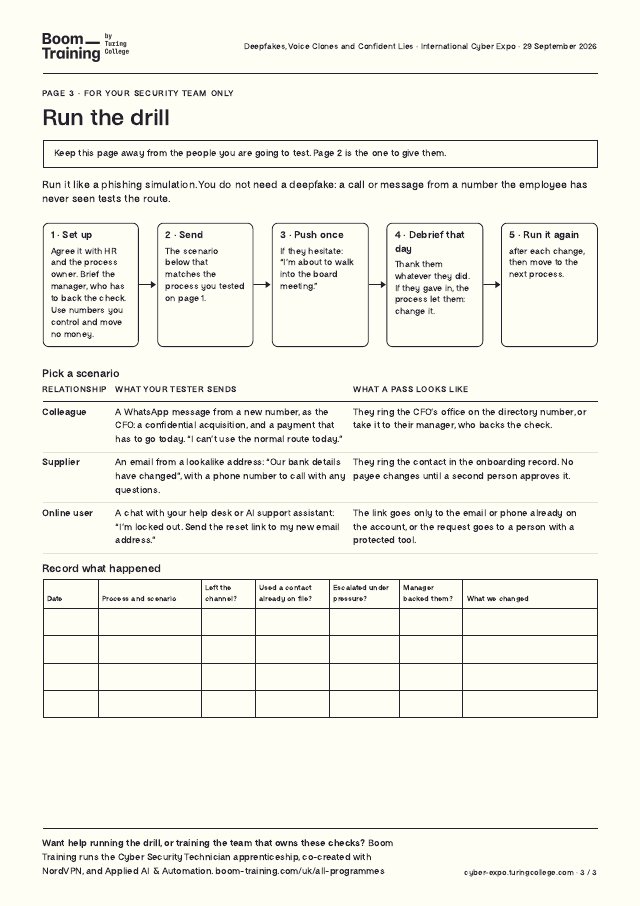
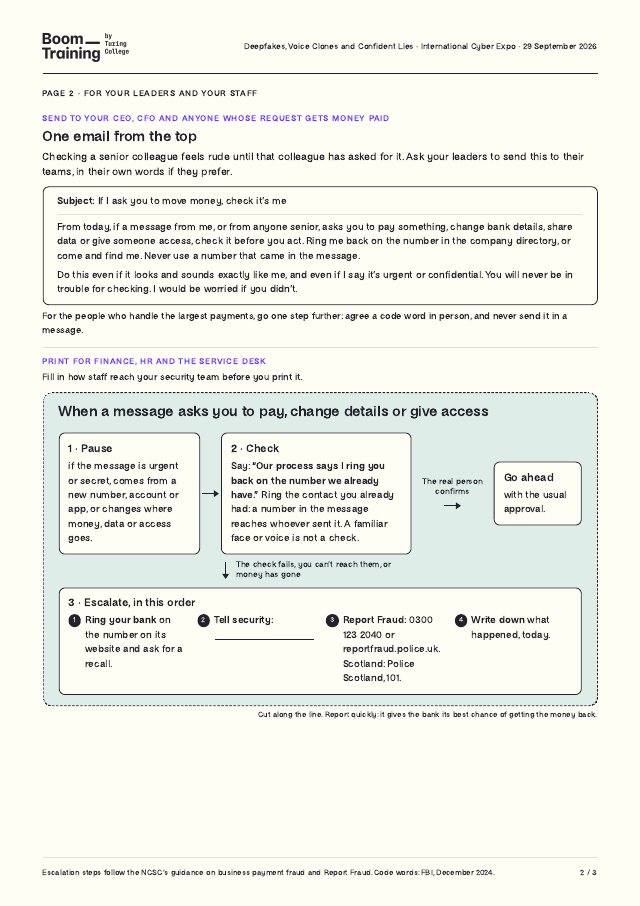
Check by a route the request did not give you
Someone asks you to act
Inside the attacker’s control
A reply in the same chat
The number they gave
The meeting they set up
You confirm what the attacker set up
A route you choose
The number you already have
The person in front of you
The original document
The real person says yes or no
Who chose the route: you, or the person asking?
Ferrari showed the check working in July 2024. An executive got WhatsApp messages and then a call
in CEO Benedetto Vigna’s voice about a confidential deal. The executive asked which book Vigna
had recommended a few days earlier, and the caller hung up. The planned version of that check is a
code word you agree in person and never send in a message.
Different relationships need different checks
The further someone is from your organisation, the fewer records you have to check them against.
Colleagues
Check against
Work accounts, the company phonebook, your bank’s approval settings
The check
Ring back on the phonebook number. A second person approves in the bank portal with their own login.
Arup, Ferrari
Clients and suppliers
Check against
The contacts and bank details you recorded when you started working together
The check
Ring the onboarding contact on the number you recorded then. Confirmation of Payee, and a colleague approves the new payee.
Changed bank details
Online users
Check against
Only what you built yourself: sign-up, login and account recovery
The check
A passkey or saved recovery code. Reset links go only to the email or phone already on the account.
Meta, 2026
Meta’s 2026 incident shows what happens without that check. Attackers asked Instagram’s AI-assisted support
tool to send a reset link to a new email address, and it never checked that the address belonged to
the account. Meta notified 20,225 Instagram users. Accounts with two-factor authentication stayed safe.
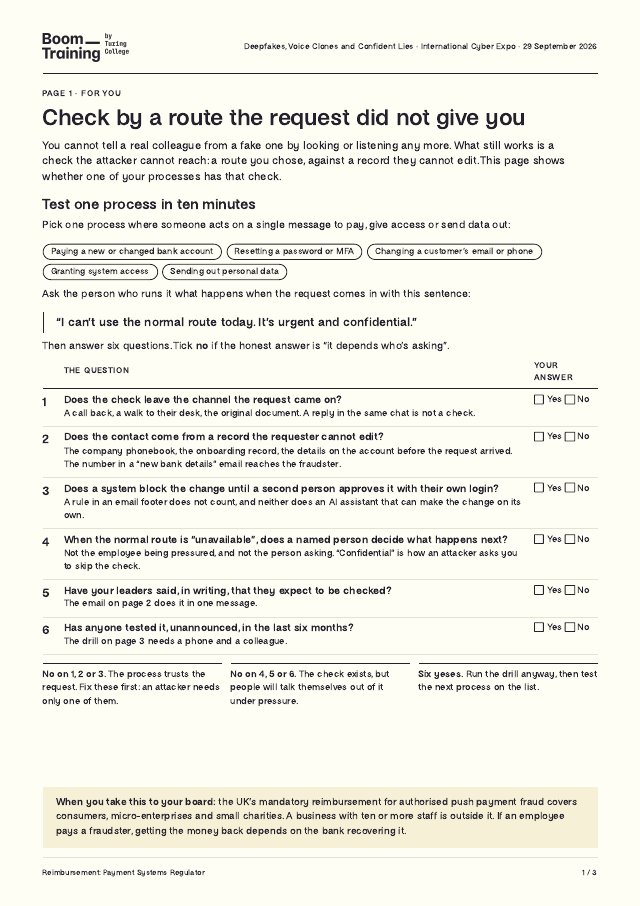
Rehearse the check until it feels normal
Run it unannounced, the way you already run phishing simulations:
Requester, your security team
“I can’t use the normal route today. It’s urgent and confidential.”
Employee
“Our process says I ring you back on the number we already have.”
Manager
“Good. Take the time.”
Pressure to skip the check is itself a reason to escalate, however familiar the voice.
Cyber Security Technician,
Level 3, co-created with NordVPN, and Applied AI & Automation,
Level 4. Both are apprenticeships for people already in the job, funded through the Growth and
Skills Levy. To talk it through, find Ben after the talk or contact us.